2026 Ducati XDiavel V4 First Ride

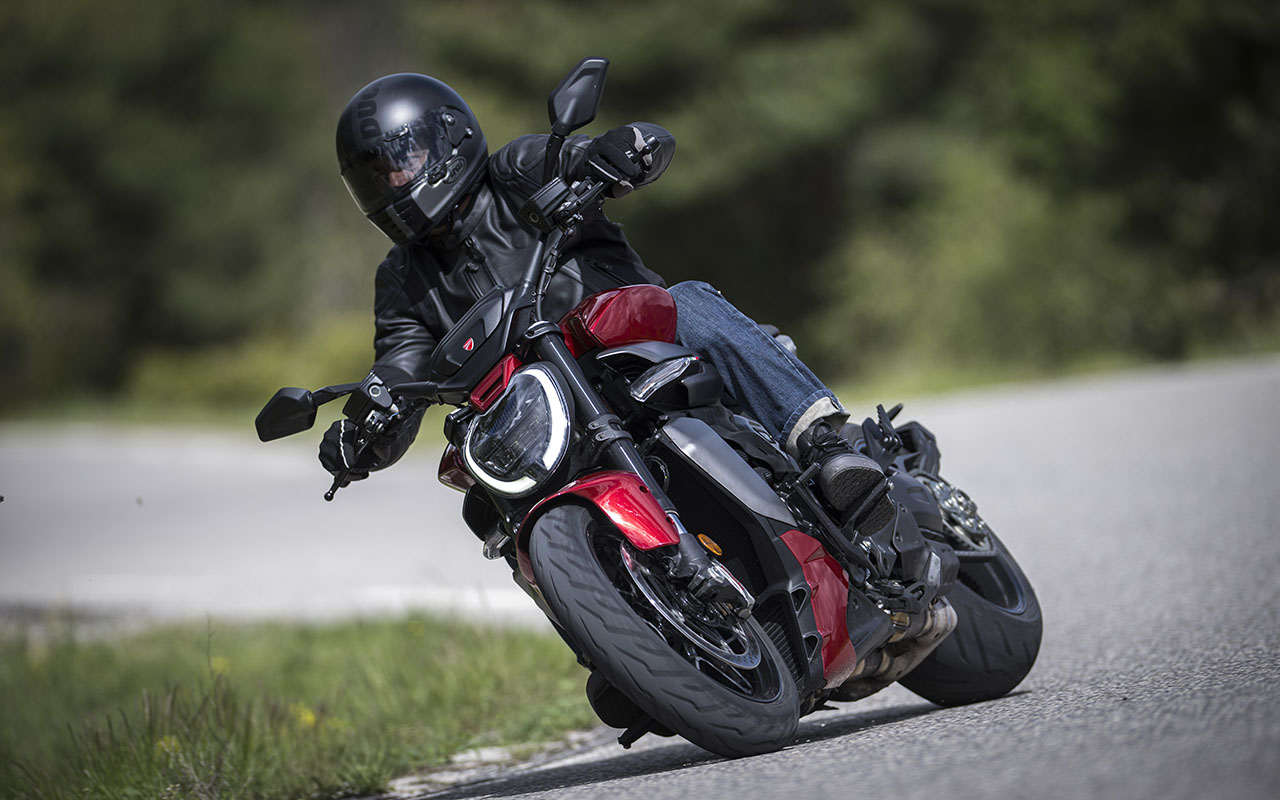


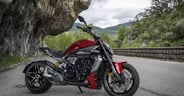
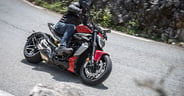

I’ve struggled to understand drag racing—or the appeal of going fast in a straight line, unless you’re running late for work, a flight, or a funeral. I even feel guilty when I’ve been road racing and passed someone on the straightaway; all that proves is that my engine has more power than yours. Hardly the kind of boast a man should be making. Oh, I understand well enough the intricacies of drag racing: getting off the line swiftly at the light, getting the power to the ground, and not spinning up the tire. But really, isn’t speed in a straight line the least sophisticated thing you can do on a motorized vehicle? That’s what I believed—right up until I rode the Ducati XDiavel V4.

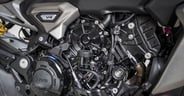
I hadn’t ridden a Diavel since the initial launch of the machine back in 2010. Back then it was powered by a 1,198 cc V-twin derived from the then-current superbike. Not much has changed in that regard, as the XDiavel on test has an engine that can trace its lineage back to the Panigale V4 superbike. That alone should give you an idea of what this bike is all about.
The Diavel—Not Your Typical Ducati
It’s a testament to the importance of the U.S. market for Ducati that this bike exists at all. In the way that luxury automotive brands like Porsche, Lamborghini, and Ferrari couldn’t ignore the SUV market, neither could Ducati overlook the sales juggernaut that the cruiser is in the U.S. And as much as Americans love horsepower, they dislike crunching their knees up and loading their wrists by leaning over onto a sportbike’s low-set clip-ons. What the U.S. market needed, according to Ducati, was a dragster for the road.

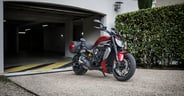
Sixteen years have passed between my rides on the bike, but the XDiavel, once I swung a leg over it, instantly reminded me of the formula. The seat is low, the footpegs are forward (shockingly so for a Ducati), and the handlebar meets you right where you want it to. At a claimed 505 lb before fuel, the bike isn’t a featherweight, yet the low (30.3-inch) seat height and center of gravity make it far more effortless to balance at a stoplight than another bike it shares its engine with, the Multistrada V4.

Making do with a healthy 168 claimed horsepower from its 1,158 cc 90-degree V4 (the Panigale V4 claims 209), the most notable difference between the engine in the XDiavel and the V4 Multistradas (excluding the Multistrada V4 RS) is that it makes do with traditional valve springs versus the sportbike’s desmodromic system. Don’t fret, however, as the upside far outweighs the downside: the Diavel and the Multistrada have valve maintenance intervals at the shockingly un-Italian rate of every 37,000 miles. Given how infrequently we in the decadent West use our motorcycles, I suspect many Diavels will never, ever reach their first scheduled maintenance.
A Cruiser That Isn’t
Credit must go to Ducati’s engineering teams, as the XDiavel is a cruiser that doesn’t behave like a traditional cruiser, in any number of ways. While the riding position will be familiar to anyone who’s ever straddled a Honda Shadow or a Harley-Davidson, Ducati has managed to sidestep one of the main drawbacks of a cruiser. While the feet-forward position is as comfortable, at rest, as a La-Z-Boy, motorcycles are dynamic vehicles. Which means that when you’re on the move, the wind pushes against your chest and cantilevers your behind down hard on the seat. On a more conventional motorcycle, where your feet rest below your hips, your body can lean forward to alleviate the wind blast. But unless you have arms like a weightlifter or a core of raw steel, a traditional cruiser at elevated highway speeds can make a short trip feel like a long one. Not so on the XDiavel.

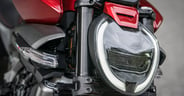
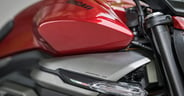
Because of the bulbous fuel tank, the angled-back, wind-deflecting nature of the headlight and instrument cluster, and the low seat height, the XDiavel creates a useful pocket of calm air altogether unexpected on a cruiser. A clever wag once wrote, of the Yamaha VMax, in many ways the spiritual predecessor to the Diavel range, that it was one of a very few bikes that genuinely offered “arm-straightening” acceleration. And that’s not because other bikes can’t accelerate with the same vigor; it’s that the cruiser riding position of the VMax had you hanging on with your arms, whereas on a sportbike you braced against the forces of acceleration with your legs. The XDiavel offers a slightly different variation on the theme. The pronounced lip at the rear of the seat locks you in position, and acceleration is felt directly at the base of the spine—replicating the sensation of hard acceleration in a car rather than on a bike.
Italian Style, American Muscle
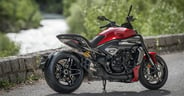
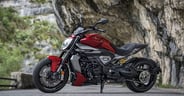
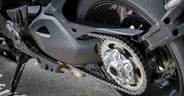
Ducati, too, references automotive practice in its literature, drawing parallels with American muscle cars, particularly in the design of the XDiavel’s massive 8-inch-wide rear wheel rim. Shod with a 240-section tire, which is considerably wider than what’s fitted to a 300 hp MotoGP racer, it’s clear that fashion, not function, plays a large part in the XDiavel’s rubber. Fitting a massive tire on the rear of a motorcycle presents considerable challenges to engineers. To avoid the sensation that the rear tire is the tail that wags the dog, Ducati engineers, in conjunction with Pirelli (which designed a Diablo Rosso III specifically for this application), have done a commendable job of mitigating the ill effects of a heavy, wide tire.

If you’ve just jumped off a bike with a more conventionally sized tire and hopped aboard the XDiavel, you’ll perceive a slight sluggishness in the way the bike accepts rider inputs, but ultimately the tire size is far less of an issue than one would expect. A contributing factor to the XDiavel’s unexpected nimbleness is the counter-rotating crankshaft, which mitigates the gyroscopic effects of the mass of a motorcycle’s rotating wheel assemblies. Irrespective of which way the crankshaft spins, the engine, like all V4s, regardless of brand, sounds wonderful. Sophisticated, rowdy, and robust, Ducati will happily sell you a noisier exhaust system (for closed-course use only, naturally), but in my estimation there’s absolutely no call for it.
Long, Low, and as Fast as Lightning
With a wheelbase a little more than five inches longer than that of the Panigale sportbike, and with a long and low presence, the Diavel range is furiously quick in a quarter-mile. How quick? An experienced rider on a stock bike can record times in the nine-second range, which makes the XDiavel about the cheapest way on the planet to reach rarified dragstrip speeds. For comparison’s sake, you’d have to spend at least another $200,000 for a car that approaches the $29,295 XDiavel’s quarter-mile performance. What’s perhaps most surprising about the XDiavel’s acceleration is how the bike retains its composure. While my time on the bike was limited to riding on public roads, which scuttled my temptation to run a nine-second quarter-mile (I’ve grown past the time in my life when prison time would have been a fair trade-off for the experience), I can attest to the addictiveness of letting the XDiavel off the leash, however slightly. The bike simply digs that fat tire into the pavement and launches. Hard.

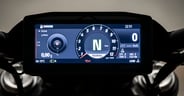
Rare is it that a motorcyclist feels glee while approaching a slow vehicle on the highway, but with the XDiavel, any chance to unleash its fury while passing is a joy to behold. Making the silliness all the more fun is the most ridiculous gauge ever seen on a motorcycle. In the lower left-hand corner of the large (6.9-inch), bright, thin-film-transistor dash is something called a g-meter. It’s a circle with a red dot—presumably the g-spot—in the middle. Under acceleration and deceleration, a reading tells you what your g-force is. It’s all good clean fun, except occasionally I became transfixed at the flashing numbers and distracted from the road ahead.
Speed, Yes. But Sophistication, Too.
Despite the XDiavel’s mind-warping acceleration, it’s important to remember that a throttle is a rheostat—it can be opened, yes, but equally it can be closed. And a motorcycle, even the XDiavel, can do all the regular things a regular motorcycle does: take you to work, or out to a café, or on a date. The bike’s fueling is excellent—smooth, progressive, and linear. And, of course, it comes with a full suite of electronic assistance: turn-by-turn GPS navigation, cornering ABS, wheelie control, traction control, and power modes. I rode the XDiavel a few hundred miles in driving rain, and with the Wet setting selected and the engine’s power knocked down, it was no more menacing than a Camry. Much wetter, mind you, but no more intimidating.

Ride quality is a mixed bag. The front end offers 4.7 inches of well-modulated control with progressive Brembo brakes that will never leave you wanting for more stopping power. At the rear, however, there’s no escaping the unsprung weight from that massive wheel-and-tire combo. Though Ducati quotes 5.7 inches of rear wheel travel, in practice it feels like considerably less than that. Allied to a cruiser riding position that doesn’t allow you to transfer weight from your buttocks to your boots, impurities in the tarmac are communicated directly to your spine. It’s not a deal breaker, but it is a reminder to pick your way through construction zones with care. Despite working the throttle as intended, the XDiavel returned a surprisingly frugal 42 miles per gallon, for a range from the 5.3-gallon fuel tank of roughly 220 miles.
Burning Red or Black Lava?
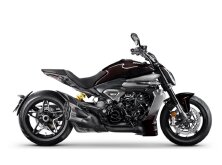
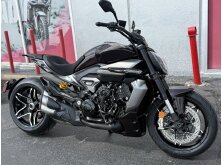
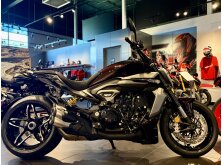
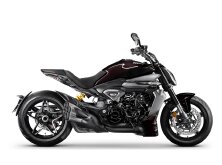
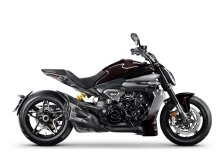
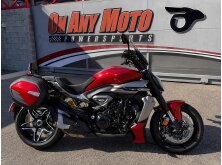
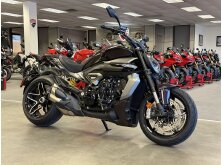
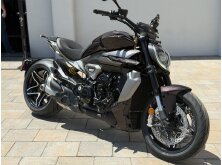
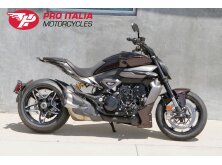
The XDiavel, I suspect, is meant for the kind of buyer who is enthralled by the aura of Ducati but who has little patience for either the physical compromises required of a superbike or the aesthetic realities of the modern ADV bike, as typified by the Multistrada. And it can’t be argued that the XDiavel is a bike with presence, especially in the color of our tester, Black Lava.

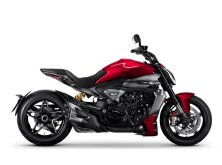
Looking like a cross of eggplant, dark mauve, dusty charcoal, and metallic coffee, it appears, at night, as plain old black. In bright daylight it comes across as something lighter than black. It’s also $300 more than the only other color, Burning Red. Irrespective of your color choice, the XDiavel is a motorcycle meant to broaden the appeal of a niche brand, and if it dovetails with what you think a power cruiser should be, then it’s a bike that’s entirely without competition.
Marketplace Inventory

 Neil Graham
You might also like


